

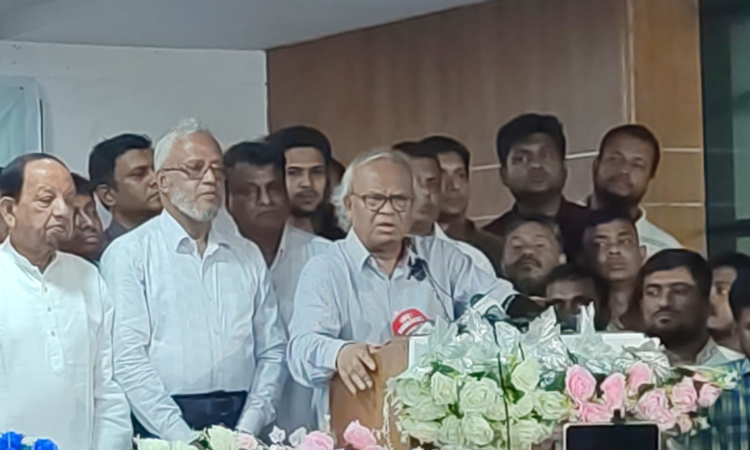
BNP Senior Joint Secretary General Ruhul Kabir Rizvi has issued a stark warning: “dangerous forces” are rising in Bangladesh, forces he claims are deliberately undermining democracy, religious freedom, and cultural diversity in a bid to impose ideological uniformity and erase political dissent. Speaking at a discussion and prayer meeting organised by the BNP at the Institution of Diploma Engineers Bangladesh (IDEB) in the capital on Sunday, Rizvi painted a grim picture of creeping authoritarianism masked as administrative reform.
“The rise of the forces we are seeing is dangerous for the country’s democracy, dangerous for the practice of democracy, and dangerous for the religious consciousness of the people,” he declared.
Rizvi argued that Bangladesh’s cultural fabric where citizens pray five times a day, yet also enjoy television dramas and music is under threat from those seeking to “make everything one-sided.” He warned: “When you erase pluralism, fascism rises. And the ultimate form of fascism is radical communalism and radical religious politics.”
Turning his focus to recent student union elections at Dhaka University (DUCSU) and Jahangirnagar University (JUCSU), Rizvi questioned whether a “deep blueprint” is being executed by the state and university authorities to marginalise nationalist and opposition-aligned student groups.
He pointed to what he called a glaring irregularity: ballot papers for both elections were printed not by a government press, as standard procedure would dictate, but by a private printing house allegedly linked to a specific political party.
“Isn’t this an irregularity?” Rizvi asked pointedly. “The ballot papers could have been printed through a government press. But they weren’t. And because of such manipulations, even respected teachers at Jahangirnagar University have resigned from election duties.”
Rizvi also took aim at Dhaka University’s Vice-Chancellor, accusing him of colluding with pro-government actors to “monopolise” campus politics.
He criticised the VC’s newly imposed code of conduct, which bars alumni from entering campus, a move Rizvi called “spiritually disconnected.”
“The university is not an isolated institution. It is a lifelong spiritual home for its alumni. To shut them out is to sever the soul of the university,” he said.
Rizvi claimed that “those who were part of the uprising in the past now seek to establish a new culture, one of dominance.”
He contrasted the BNP’s “soil-rooted” political and cultural identity with what he described as Jamaat-e-Islami’s agenda to propagate “Maududi’s ideology”, a reference to the late Islamist politician Abul Ala Maududi, whose ideas underpin much of modern political Islam in South Asia.
“Islam was established in this country long ago,” Rizvi said. “If certain groups now want to re-propagate a rigid, imported version of Islam, the people will have their own opinion and their own resistance.”
In perhaps his most incendiary remark, Rizvi alleged that a coordinated “master plan” is underway between state actors and university authorities: “We drove out the Awami League — now we must drive out the BNP too.” He asked: “Isn’t this part of their deep blue design?”
He warned that if such unilateralism continues unchecked, “a new kind of fascism will be born — one that will destroy our national consciousness, our diversity, and our democratic soul.”