

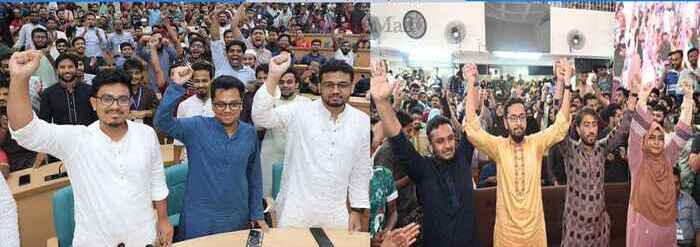
Islamic Chhatra Shibir has stormed to a sweeping victory in the student union elections at Bangladesh’s two most prestigious public universities. The Jamaat-e-Islami–backed student wing clinched decisive wins in both the Dhaka University Central Students’ Union (DUCSU)—after a gap of six long years—and the Jahangirnagar University Central Students’ Union (JUCSU), breaking a drought of 33 years.
In an astonishing show of dominance, Shibir-backed candidates seized not only the coveted top positions but also the lion’s share of posts—23 seats in DUCSU, including the all-important VP and GS, and more than 20 posts in JUCSU.
Traditionally, Shibir had never held such influence in these campuses, making the results unprecedented. With Chittagong University and Rajshahi University elections scheduled next, analysts expect similarly strong outcomes there, as Shibir has long maintained organizational strength in both institutions.
Observers attribute Shibir’s sudden surge to several factors: the momentum of the July uprising, a year-long preparation campaign, consistent engagement in residential halls, and the presentation of an inclusive panel that resonated with general students. The elections are being seen as the beginning of a new chapter in campus politics.
Unlike other student organizations, Shibir announced its DUCSU panel well in advance—six months before the election—putting forward Abu Sadiq Kayem for VP and S.M. Forhad for GS. Their strategy was not only to win but also to build inclusivity: the panel featured four women and one Chakma student, as well as candidates both with and without hijab.
After the July uprising, when many students opposed partisan politics in halls, Shibir strategically maintained a low political profile while staying connected through welfare initiatives, student support, and social activities. This long-term relationship-building became a cornerstone of their electoral success. International media, including Al Jazeera, even highlighted Abu Sadiq Kayem as an organizer of the July movement, further elevating his profile.
Other student groups, meanwhile, struggled with internal divisions, ideological rifts, and weak campaigns. Shibir’s well-funded, strategically organized, and consistent presence gave them a decisive edge. Analysts argue this was not merely the outcome of a 20-day campaign but the culmination of long-term groundwork.
Shibir-backed candidates, running under the banner “United Students’ Alliance,” secured 23 out of 28 DUCSU posts, including 11 of the 13 central member positions. Kayem won the VP post with 14,042 votes, Forhad became GS with 10,794 votes, and Mahiyuddin Khan clinched the AGS post with 11,772 votes.
Students believe these results were not accidental but the product of systematic planning, outreach, and credibility-building. By focusing on welfare activities, inclusivity, and steady hall-level networking, Shibir earned trust that translated into votes. Some see it as the reflection of new-generation aspirations; others describe it as the result of long-hidden strategic maneuvering.
Political analysts highlight a sharp contrast with BNP’s student wing, Jatiyatabadi Chhatra Dal (JCD). According to Dr. Mamun Al Mostafa, Professor of Political Science at Dhaka University, JCD was virtually absent from campuses since 2006 and never regained continuity, while Shibir and other Islamist student groups adapted their strategies to survive. “They operated openly during BNP’s tenure and shifted to covert activities during Awami League’s rule, even embedding themselves inside Chhatra League to sustain their networks,” he explained.
He noted that such long-standing committees and networks naturally expand over time, giving Shibir resilience, while JCD’s sudden reactivation after a 15-year absence left them organizationally weak. Their new committees lacked hall-level roots, whereas Shibir leveraged old networks and social ties to full effect.
Dr. Sabbir Ahmed, another Political Science professor at Dhaka University, echoed this view. He argued that Shibir had been preparing for years, targeting specific constituencies with deliberate strategies, while JCD’s disarray and negative national image—tied to extortion, tender manipulation, and weakness during the July movement—further eroded student confidence. Shibir, by contrast, carefully curated its messaging, timing, and campaign narratives.“Politics rewards those who stay on the ground,” Dr. Ahmed said. “BNP and JCD remained absent, while Shibir and allied groups maintained consistent presence. In the end, those who held the field gained the advantage.”
The DUCSU and JUCSU results mark a significant shift in student politics, suggesting that Shibir’s combination of inclusivity, covert resilience, and long-term preparation has opened a new era on Bangladesh’s campuses.
In an astonishing show of dominance, Shibir-backed candidates seized not only the coveted top positions but also the lion’s share of posts—23 seats in DUCSU, including the all-important VP and GS, and more than 20 posts in JUCSU.
Traditionally, Shibir had never held such influence in these campuses, making the results unprecedented. With Chittagong University and Rajshahi University elections scheduled next, analysts expect similarly strong outcomes there, as Shibir has long maintained organizational strength in both institutions.
Observers attribute Shibir’s sudden surge to several factors: the momentum of the July uprising, a year-long preparation campaign, consistent engagement in residential halls, and the presentation of an inclusive panel that resonated with general students. The elections are being seen as the beginning of a new chapter in campus politics.
Unlike other student organizations, Shibir announced its DUCSU panel well in advance—six months before the election—putting forward Abu Sadiq Kayem for VP and S.M. Forhad for GS. Their strategy was not only to win but also to build inclusivity: the panel featured four women and one Chakma student, as well as candidates both with and without hijab.
After the July uprising, when many students opposed partisan politics in halls, Shibir strategically maintained a low political profile while staying connected through welfare initiatives, student support, and social activities. This long-term relationship-building became a cornerstone of their electoral success. International media, including Al Jazeera, even highlighted Abu Sadiq Kayem as an organizer of the July movement, further elevating his profile.
Other student groups, meanwhile, struggled with internal divisions, ideological rifts, and weak campaigns. Shibir’s well-funded, strategically organized, and consistent presence gave them a decisive edge. Analysts argue this was not merely the outcome of a 20-day campaign but the culmination of long-term groundwork.
Shibir-backed candidates, running under the banner “United Students’ Alliance,” secured 23 out of 28 DUCSU posts, including 11 of the 13 central member positions. Kayem won the VP post with 14,042 votes, Forhad became GS with 10,794 votes, and Mahiyuddin Khan clinched the AGS post with 11,772 votes.
Students believe these results were not accidental but the product of systematic planning, outreach, and credibility-building. By focusing on welfare activities, inclusivity, and steady hall-level networking, Shibir earned trust that translated into votes. Some see it as the reflection of new-generation aspirations; others describe it as the result of long-hidden strategic maneuvering.
Political analysts highlight a sharp contrast with BNP’s student wing, Jatiyatabadi Chhatra Dal (JCD). According to Dr. Mamun Al Mostafa, Professor of Political Science at Dhaka University, JCD was virtually absent from campuses since 2006 and never regained continuity, while Shibir and other Islamist student groups adapted their strategies to survive. “They operated openly during BNP’s tenure and shifted to covert activities during Awami League’s rule, even embedding themselves inside Chhatra League to sustain their networks,” he explained.
He noted that such long-standing committees and networks naturally expand over time, giving Shibir resilience, while JCD’s sudden reactivation after a 15-year absence left them organizationally weak. Their new committees lacked hall-level roots, whereas Shibir leveraged old networks and social ties to full effect.
Dr. Sabbir Ahmed, another Political Science professor at Dhaka University, echoed this view. He argued that Shibir had been preparing for years, targeting specific constituencies with deliberate strategies, while JCD’s disarray and negative national image—tied to extortion, tender manipulation, and weakness during the July movement—further eroded student confidence. Shibir, by contrast, carefully curated its messaging, timing, and campaign narratives.“Politics rewards those who stay on the ground,” Dr. Ahmed said. “BNP and JCD remained absent, while Shibir and allied groups maintained consistent presence. In the end, those who held the field gained the advantage.”
The DUCSU and JUCSU results mark a significant shift in student politics, suggesting that Shibir’s combination of inclusivity, covert resilience, and long-term preparation has opened a new era on Bangladesh’s campuses.