

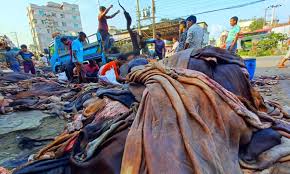
The government, as in previous years, fixed prices for sacrificial animal hides in an effort to ensure fair market value. However, the declared rates have largely failed to materialize in the marketplace. Across different parts of the capital, raw hides from sacrificial animals were sold at prices far below the government-set rates, triggering frustration among seasonal traders, madrasa authorities, and orphanage administrators.
This year, the government set the price of salted cowhide in Dhaka at Tk 62 to Tk 67 per square foot, an increase of Tk 2 from the previous year. Despite the hike, stakeholders claim that the official rates have had little impact on actual market transactions.
Every year during Eid-ul-Azha, madrasas and orphanages collect the largest share of sacrificial animal hides. Many donors voluntarily contribute hides to these institutions, which rely heavily on the proceeds to fund orphanages, Lillah boarding facilities, and educational expenses for underprivileged students. However, years of poor returns from hide sales have placed these institutions under increasing financial pressure, reducing their enthusiasm for collecting hides.
Visits to several areas of Dhaka, including Moghbazar, Mugda, Mohammadpur, Dhanmondi, Kalabagan, Science Lab, Shewrapara, and Posta in Lalbagh, revealed that small-sized cowhides were selling for Tk 250–450, medium-sized hides for Tk 500–650, and large hides for Tk 700–900. Under government rates, however, a medium-sized hide should have fetched approximately Tk 1,300–1,850, while a large hide was expected to be worth between Tk 2,000 and Tk 2,500 or more.
Seasonal traders allege that although the government increased official prices, they received no assurance from tannery owners that hides would actually be purchased at those rates. As a result, the market was affected by low prices from the outset.
According to traders, transactions at the grassroots level are largely determined by the rates offered by tannery owners. Consequently, the ultimate losers are sacrificial animal owners, mosques, madrasas, and orphanages.
Jafar, a seasonal trader from Malibagh, said he took 15 cowhides to market for sale. Although he initially asked Tk 1,000 per hide, buyers were unwilling to offer more than Tk 650. Even after lowering the price to Tk 800, he failed to find any buyers.
“Last year I sold similar hides for Tk 800 to Tk 900. This year nobody wants to pay more than Tk 600–650. The government may have increased prices, but it has had no effect on the market,” he said.
A similar picture emerged in other parts of the capital. Mohammad Swapan, a seasonal trader operating on Sher Shah Suri Road in Mohammadpur, said he purchased small hides for Tk 450, medium hides for Tk 500–550, and large hides for Tk 600–650.
“We buy according to the prices offered by tannery owners. If we pay more, we will incur losses,” he explained.
Abid Hossain Hanif, another trader from the Science Lab area, echoed the same sentiment. He said hide prices have fallen compared with last year, but traders have little choice since they are forced to sell to tanneries at lower rates.
The market for goat hides has also collapsed. In several areas of Dhaka, goat hides were sold for as little as Tk 5–10 each. In some cases, traders reportedly collected the hides without paying anything at all.
A trader in Dhanmondi said goat hides have become a burden because the costs of preservation often exceed their market value.
The biggest victims of this market instability are madrasas and orphanages, which depend heavily on annual hide collections for a significant portion of their operating expenses. Due to poor returns, many institutions are no longer prioritizing hide collection as they once did.
Maulana Bahauddin Zakaria, principal of Arzabad Madrasa in Mirpur, said, “The prices announced by the government are not implemented in reality. We do not receive fair value for the hides we collect, and many institutions are losing interest in the process.”
Mahbubullah, principal of Nazmul Haque Madinatul Ulum Kamil Madrasa in Khilgaon, described hides as a national asset. “Yet this sector is being systematically weakened every year. If fair prices are not ensured, religious educational institutions will suffer even greater losses,” he said.
Tannery owners, however, reject allegations of falling prices. Md. Sakhawat Ullah, Senior Vice-Chairman of the Bangladesh Tanners Association, claimed that hide prices have not decreased and have actually increased by Tk 20–50 compared with last year.
“I personally purchased hides at prices ranging from Tk 650 to Tk 950. The market takes time to become fully active, and prices may rise further in the afternoon and evening,” he said.
He added that many tanneries are purchasing hides directly from the field this year to stabilize the raw hide market in the capital. According to him, lower prices observed earlier in the day may have resulted from sluggish trading activity.
Traders, however, maintain that the reality on the ground tells a different story. Even after trading picked up in the evening at Posta, prices showed little improvement. Large hides sold for Tk 750–900, medium hides for Tk 600–700, and small hides for Tk 150–500.
According to the Department of Livestock Services, the country’s demand for sacrificial animals this year was approximately 10.1 million, while around 12.334 million animals were prepared for sacrifice.
Traders believe the number of sacrifices may decline slightly this year. Reflecting that concern, tannery owners have reportedly set a target of collecting 7.5 to 8 million hides, lower than last year’s figure.
Industry stakeholders argue that a lack of transparency has long plagued the hide market. While the government announces official prices, there is little effective enforcement. Seasonal traders remain dependent on tanneries and major wholesalers, forcing them to buy and sell hides at lower rates.
According to traders, preserving a raw hide costs between Tk 300 and Tk 350 on average, including expenses for salt, labor, and transportation. As a result, current market prices are often less than half of what they should be under the government’s pricing structure.
They further allege that although the government announces prices before Eid every year, there is little meaningful market oversight. This allows influential traders and tannery owners to control the market through syndication, undermining the entire leather sector.
Experts argue that ensuring fair prices requires more than simply announcing rates. Effective market monitoring, improved preservation facilities, greater transparency within the tannery industry, and stronger measures against middlemen are essential. Without such reforms, one of the country’s most promising industries may face deeper challenges, with madrasas, orphanages, and small traders bearing the heaviest burden.