

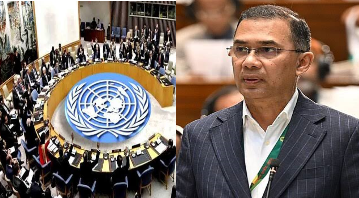
Prime Minister Tarique Rahman’s maiden address to the 81st Session of the United Nations General Assembly and his five-day visit to New York have drawn considerable attention in Bangladesh’s political and diplomatic circles. During his address at the UN General Assembly in New York on September 24, the Prime Minister presented Bangladesh’s perspectives on democracy, the rule of law, human rights, peace, economic self-reliance, climate change, the Rohingya crisis and inclusive development.
The government has described the visit as an important chapter in Bangladesh’s diplomatic engagement with the international community and as an opportunity to present the country’s democratic aspirations and national interests on the global stage. According to government officials, the Prime Minister’s engagements focused on trade, investment, climate action, humanitarian issues, economic cooperation, the Rohingya crisis and international peace.
A Third Member of the Same Family to Address the UN
Tarique Rahman’s address to the UN General Assembly also carries historical significance in the political history of Bangladesh. He became the third member of his family to address the UN General Assembly, following his father, President Ziaur Rahman, and his mother, former Prime Minister Khaleda Zia. Bangladesh Sangbad Sangstha (BSS) described the event as a historic occasion for Bangladesh.
The 81st session of the General Assembly has another significant Bangladeshi connection. Foreign Minister Khalilur Rahman is serving as President of the 81st Session of the UN General Assembly. He was elected to the position on June 2, 2026, and assumed the presidency when the session opened on September 8. The United Nations identifies him as the President of the General Assembly for the 81st session.
In his opening remarks as General Assembly President, Khalilur Rahman expressed his gratitude to Prime Minister Tarique Rahman and the Government of Bangladesh for nominating him for the position.
Democracy and Economic Reconstruction
In his first address to the UN General Assembly as Prime Minister, Tarique Rahman outlined his government’s vision for rebuilding and transforming Bangladesh. He spoke about strengthening democracy, empowering citizens, rebuilding institutions and creating a prosperous and self-reliant economy.
A central element of his economic vision was the “3-R” strategy—Recovery, Restoration and Reconstruction. The government has presented the strategy as a framework for addressing the country’s economic and institutional challenges while creating new opportunities for development.
The Prime Minister also highlighted the importance of young people, entrepreneurs, researchers and innovators in Bangladesh’s future economic development. His government has announced a $50 million allocation for startup initiatives aimed at supporting young entrepreneurs, researchers and innovators.
His speech also placed emphasis on women, children and young people, with a vision of a Bangladesh where citizens can pursue their aspirations, women can participate more confidently in society and children can grow in a safe and supportive environment.
The Rohingya Crisis and Global Challenges
The Rohingya crisis remained one of Bangladesh’s major diplomatic priorities during the New York visit.
At the General Assembly, Prime Minister Tarique Rahman called for the safe and dignified return of displaced Rohingyas to their homeland in Myanmar. He noted that Bangladesh has been hosting more than 1.2 million forcibly displaced Rohingyas for more than nine years and argued that the root of the crisis lies in Myanmar and therefore its lasting solution must also be found there.
The Prime Minister also participated in a high-level event on the Rohingya crisis on the sidelines of the General Assembly. The event was attended by senior international representatives and focused on finding a durable solution to the prolonged displacement.
Climate change was another major issue during the visit. The Prime Minister took part in discussions concerning climate action and a just transition, as well as the growing risks posed by sea-level rise to coastal and vulnerable countries. These issues are particularly important for Bangladesh, one of the countries highly exposed to the consequences of climate change. The UN’s official schedule confirms that high-level meetings on climate action and sea-level rise were among the major events of the 81st General Assembly.
Meetings with World Leaders
The Prime Minister’s programme in New York included an extensive series of bilateral and multilateral meetings.
According to official information reported by BSS, Tarique Rahman took part in 30 engagements during his four working days in New York, including 11 bilateral meetings with countries, eight UNGA-related engagements and 11 institutional engagements. Members of his delegation participated in approximately 80 engagements altogether.
Among the leaders he met were Turkish President Recep Tayyip Erdoğan, Iranian President Masoud Pezeshkian, Pakistani Prime Minister Muhammad Shehbaz Sharif, Croatian Prime Minister Andrej Plenković, Haitian Prime Minister Alix Didier Fils-Aimé, Bhutanese Prime Minister Tshering Tobgay and Thai Prime Minister Anutin
The meetings covered bilateral relations, trade, investment, regional cooperation, energy, development and international affairs.
The Prime Minister also met senior officials of the United Nations, the World Bank and other international organisations. These engagements provided opportunities to discuss Bangladesh’s development priorities and strengthen international partnerships.
Economic Diplomacy and Investment
Economic diplomacy was another important component of the New York visit.
The Prime Minister met representatives of Wall Street at a breakfast meeting organised by JPMorgan. Discussions focused on Bangladesh’s economy, investment opportunities and the country’s potential for deeper engagement with international investors.
The government has emphasised expanding partnerships with other countries, increasing trade and attracting foreign investment as part of its broader strategy to strengthen economic self-reliance.
From the government’s perspective, international economic partnerships are expected to create new opportunities for employment, investment and inclusive development.
“Bangladesh First” on the Global Stage
Government officials have repeatedly described “Bangladesh First” as a central message of the Prime Minister’s diplomatic engagement.
According to the Prime Minister’s Office, national interests, sovereignty and the dignity of Bangladesh remained central to the Prime Minister’s meetings and statements during the visit.
Government representatives also said that the Prime Minister used the global platform to present Bangladesh’s democratic journey and outline the country’s vision for peace, development and multilateral cooperation.
The official narrative surrounding the visit therefore placed particular emphasis on Bangladesh’s national interests while seeking stronger partnerships with countries and international institutions.
Dr Zubaida Rahman’s International Engagements
Prime Minister Tarique Rahman’s wife, Dr Zubaida Rahman, also took part in several international programmes during the visit.
According to government officials, she participated in eight engagements over the four working days and delivered remarks at three of them.
Her activities focused particularly on women’s leadership, maternal and child health and midwifery. She participated in international programmes involving women leaders and spouses of heads of state and government, where she presented Bangladesh’s experience and policy priorities in maternal and child healthcare.
Her participation added a social and health-focused dimension to the Prime Minister’s broader diplomatic programme.
The Real Test Lies at Home
The New York visit has given Bangladesh an opportunity to present its priorities and aspirations before the international community. However, the longer-term significance of the visit will depend largely on how the government translates its international commitments into concrete results at home.
The government has spoken of economic reconstruction, job creation, investment, improved healthcare, education, human security, democratic governance and inclusive development. Delivering measurable progress in these areas will be central to assessing the effectiveness of its policies.
The government has also expressed its intention to produce visible development outcomes within the first several months of its administration. Whether these ambitions translate into improvements in people’s daily lives will depend on policy implementation, institutional capacity, political stability, economic conditions and the wider global environment.
A New Chapter in Bangladesh’s Global Engagement
Prime Minister Tarique Rahman’s participation in the 81st UN General Assembly has placed Bangladesh’s democratic aspirations, economic priorities and international interests before a broad global audience.
His maiden UN address focused on peace, democracy, reconstruction, economic self-reliance, climate action, human development and a durable solution to the Rohingya crisis. His extensive diplomatic schedule also demonstrated an effort to broaden Bangladesh’s engagement with world leaders, international organisations an important diplomatic platform for the government to communicate its vision of and global investors.
The New York visit may therefore be viewed as an important diplomatic platform for the government to communicate its vision of a democratic, peaceful, prosperous and self-reliant Bangladesh.
The next challenge, however, lies in translating that vision into tangible outcomes for the people of Bangladesh. The success of the government’s international message will ultimately be reflected not only in diplomatic engagements abroad, but also in economic stability, institutional reform, employment, investment, public services and the everyday lives of its citizens.