

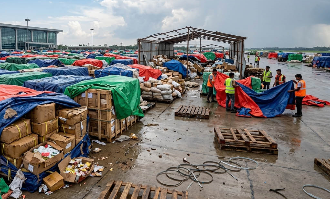
Thousands of crores of taka worth of imported goods are reportedly being damaged by rain and scorching sunlight at Hazrat Shahjalal International Airport in Dhaka, as the airport has yet to rebuild its only cargo village and permanent cargo shed that were destroyed by fire last year.
The airport’s sole cargo village and the approximately 158,000-square-foot permanent shed in front of it were gutted by fire on October 18 last year. Although authorities had promised to construct a new cargo shed quickly, no permanent replacement has been built even after nearly 11 months. As a result, large quantities of imported goods are being kept in the open air. Importers allege that they are still being charged storage fees despite the lack of adequate storage facilities.
Businesspeople say authorities had promised immediate steps to build a new cargo shed after the fire, but the promised facility has yet to materialise. Meanwhile, imported goods are being exposed to rain during the monsoon, causing significant losses. Young entrepreneurs operating with limited capital are reportedly among those suffering the most.
On average, around 50 flights land at Hazrat Shahjalal International Airport every day. Of these, eight to 10 are chartered cargo flights, while 40 to 45 are passenger flights carrying commercial goods. More than 600 tonnes of imported goods arrive at the airport daily from different countries.
It takes an average of three to four days to clear goods arriving on chartered cargo flights. As a result, between 2,000 and 2,500 tonnes of goods remain stored at the airport at any given time. Importers reportedly have to pay between Tk 20,000 and Tk 60,000 in storage charges on average for their consignments.
Importers say the absence of a permanent shed has forced authorities to keep goods in open areas, exposing them to rain and sunlight and compromising their quality. According to data from the Bangladesh Meteorological Department, Dhaka experienced rainfall on 20 days in July and 15 days in August this year. During periods of prolonged rain, many goods kept in open areas at the airport reportedly became wet and damaged, with some consignments allegedly being completely ruined.
Young entrepreneurs have been particularly affected. Mobile phone accessories, gadgets and electronic products imported from China and other countries are reportedly being damaged by rainwater. Importers of raw materials for the garment and pharmaceutical industries are also facing difficulties, as prolonged exposure to rain and sunlight makes it difficult to maintain the quality of their goods.
SkyBuy BD imports products from China for young entrepreneurs. Its founder and chief executive officer, Russell Bin Ahad, said the company suffered losses of around Tk 2.5 crore when the cargo shed caught fire last year.
He said the company was also required to pay approximately Tk 2.5 crore in customs duties because the imported goods had already been recorded in the National Board of Revenue’s software. Despite accepting the losses and complying with the required procedures, he said, no new shed had been constructed in the past 11 months.
“As soon as the goods arrive, they have to be kept under the open sky, where they are exposed to rain and sunlight,” Russell said.
He also questioned the collection of storage fees. According to him, importers are charged storage fees for their consignments even though adequate storage facilities are not available. He said the resulting damage was causing not only financial losses but also harming the business reputation of young entrepreneurs.
Another entrepreneur, who requested anonymity, said he imports gadgets with limited capital. According to him, he has watched helplessly as rainwater soaked his goods, leaving him with little opportunity to protect them.
He alleged that, after failing to receive tarpaulins from the authorities, he had to purchase them himself from outside to cover his goods. He further alleged that he was forced to pay Tk 10,000 in bribes to have the goods covered. He called for entrepreneurs to be allowed to arrange temporary or permanent sheds at their own expense.
The entrepreneur also expressed concern that speaking publicly could expose him to harassment during future import procedures.
Khairul Kabir Bhuiyan Mithu, vice-president of the Dhaka Customs Agents Association, said keeping goods on the ground in an open area inevitably exposes them to rainwater from above as well as water rising from the ground.
He described the prolonged delay in repairing the cargo shed damaged by the fire as a major failure.
Airport authorities, however, have attributed the congestion partly to delays in clearing imported goods. Group Captain Ragib Samad, executive director of Hazrat Shahjalal International Airport, said the volume of cargo arriving at the airport was higher than the rate at which C&F agents and importers were clearing their consignments.
As a result, he said, the airport was facing a shortage of space.
Ragib Samad said repairing and reopening the fire-damaged facility was not an easy task. He acknowledged that goods had been getting wet during the monsoon but said the situation could have been avoided to some extent if consignments had been cleared promptly after arrival.
He also pointed to certain limitations faced by the airport authorities and said a permanent solution to the problem would require waiting until the third terminal becomes operational.
Importers, however, argue that waiting for the third terminal while the existing crisis continues could result in further damage to imported goods. They are calling for the authorities to urgently ensure adequate covered storage facilities and review the justification for collecting storage charges where sufficient storage facilities are unavailable.