

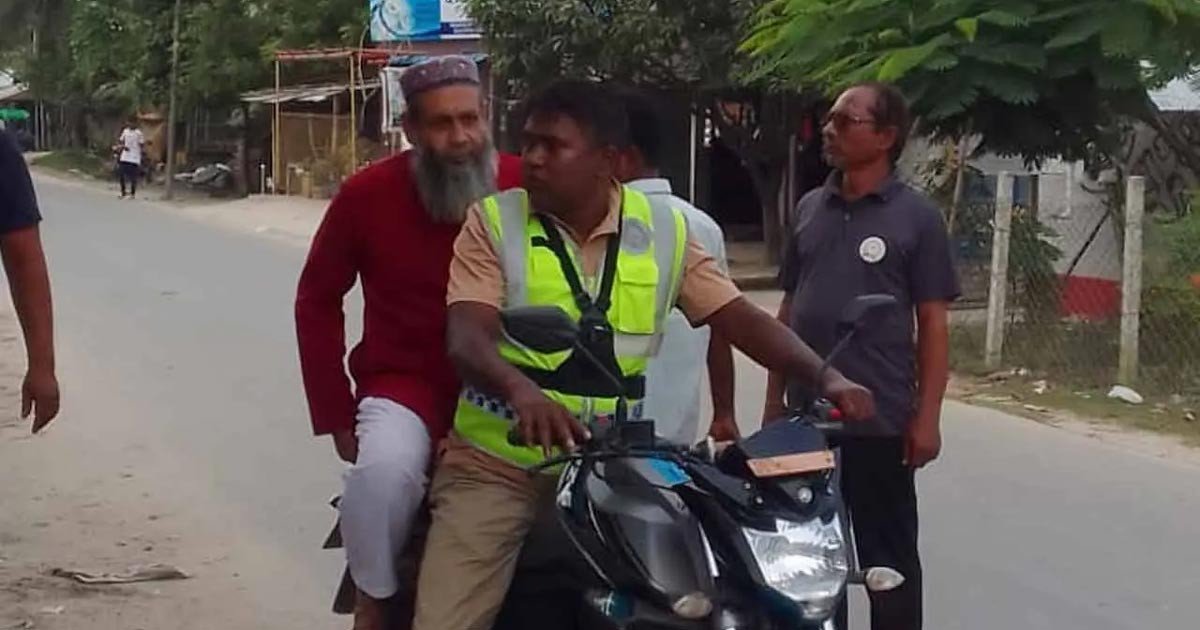
The detention of a schoolteacher in Daulatpur, Kushtia, over allegations that he made derogatory and objectionable remarks about Prime Minister Tarique Rahman during a classroom session has drawn attention in the political and social spheres. Following the teacher’s detention, the Prime Minister reportedly instructed the authorities to release him and ensure that he was safely escorted home.
According to Mahdi Amin, spokesperson for the Prime Minister’s Office and an adviser to the Prime Minister, the decision was based on the principle that every citizen’s right to express an opinion should be respected, even when that opinion differs from that of the government or the Prime Minister.
The incident took place at Pragpur Secondary School in Daulatpur, Kushtia. The detained teacher, Golam Kibria Lalon, teaches Bangla at the school. According to reports published by several media outlets, the issue arose during a Bangla class for tenth-grade students on Tuesday, when the subject of Prime Minister Tarique Rahman’s recent speech in Bangla came up.
Students reportedly alleged that the teacher made remarks concerning the Prime Minister’s Bangla pronunciation. However, the school’s headteacher said that Golam Kibria denied making any derogatory comments. According to the headteacher, the teacher had merely observed that the Prime Minister’s pronunciation might have become somewhat less fluent because he had spent many years outside the country.
The incident subsequently generated a reaction among local students, parents and residents. On Wednesday morning, several parents and local residents gathered on the school premises and demanded action against the teacher. Police later took the teacher into custody amid the situation. According to reports, he was detained at around 11 a.m. on Wednesday in the Pragpur area along the Bheramara–Pragpur regional highway.
The incident took a different turn later in the day after a statement from the Prime Minister’s Office. In a Facebook post shortly after midnight on Wednesday, Mahdi Amin said that, after learning about the incident and the tensions surrounding it, the Prime Minister instructed the concerned police station to release the teacher respectfully and ensure his safe return home. The teacher was subsequently escorted home by police. The same information was also reported by media outlets citing the officer-in-charge of Daulatpur Police Station.
According to Mahdi Amin, the Prime Minister’s decision reflected a broader principle concerning tolerance and respect for differing opinions. He said that people may have different views and perspectives, and that everyone has the right to express their own opinion. Even when one disagrees with another person’s views, the individual’s right to express those views should be respected.
The Prime Minister, according to his spokesperson, regards respect for freedom of expression and differing opinions as an important strength of democracy. He also believes that positive behaviour, mutual respect and a culture of peaceful coexistence can contribute to a stronger society.
The politically sensitive incident has therefore brought two issues into focus. On one hand, there is the allegation that a teacher made objectionable remarks about a senior political figure in a classroom. On the other hand, there is the question of how the state responds when an individual is accused of making such remarks.
The exact nature of the teacher’s comments and whether they amounted to an offence remain separate matters that require appropriate determination. However, the position communicated by the Prime Minister’s Office emphasizes that differences of opinion should not become a reason for intimidation, harassment or unnecessary hostility. Instead, tolerance, mutual respect and restraint should guide interactions in a democratic society.
Political disagreement is a normal feature of a democratic system. Citizens may express criticism of government policies, political leaders or public institutions. At the same time, the exercise of freedom of expression carries responsibilities concerning the law, civility and the rights of others.
Against this backdrop, the Daulatpur incident has emerged as more than an isolated case involving the detention and subsequent release of a schoolteacher. It has also prompted discussion about freedom of expression, respect for dissent and political tolerance.
The message conveyed by the Prime Minister’s Office is that differences of opinion should be accommodated within a culture of mutual respect. Regardless of whether people agree with one another, treating others with dignity and allowing space for differing views can contribute to social trust and democratic coexistence. The Kushtia incident has consequently become a point of discussion about how such principles can be reflected in the conduct of public authorities and society at large.