

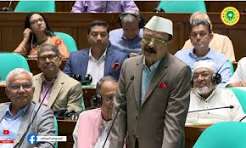
BNP lawmaker Gayeshwar Chandra Roy on Saturday defended the proposed national budget for FY2026–27, arguing that it would have needed to be at least Tk30 lakh crore to meet all the development demands raised by members of parliament. He rejected criticism that the proposed budget is excessively large, saying Bangladesh's development aspirations require substantial public spending.
Participating in the general discussion on the proposed budget in the Jatiya Sangsad, Roy said the cumulative demands for roads, schools, colleges, hospitals, and other public infrastructure far exceed the size of the proposed budget.
Expressing his support for the budget, the senior BNP leader said it reflects the government's vision but emphasized that its success would ultimately depend on eliminating corruption and ensuring effective implementation.
Roy noted that the budget had been formulated in line with the vision outlined by Prime Minister Tarique Rahman.
"When Tarique Rahman returned to Dhaka, he said, 'I have a plan.' This budget has been prepared in accordance with that vision," he said.
Defending the proposed budget deficit, Roy argued that deficit financing is a normal feature of public finance and should not be viewed negatively.
"A family budget is based on income before expenditure, whereas a national budget determines revenue requirements based on expenditure needs. That is the fundamental difference," he said.
However, he identified corruption as the biggest obstacle to successful budget implementation and urged the government to adopt a policy of zero tolerance.
"It is not enough simply to oppose corruption. We need zero per cent corruption. If we can ensure zero tolerance against corruption, the budget can be implemented successfully," he said.
Roy also alleged that corruption in revenue collection continues to deprive the government of legitimate income, thereby weakening the country's fiscal capacity.
Welcoming the proposed allocations for social protection and family welfare programmes, he said direct financial assistance to women and low-income households would stimulate economic activity by increasing the circulation of money.
"When this money reaches women and low-income families, it circulates throughout the economy. The more money changes hands, the stronger the economy becomes," he observed.
The BNP lawmaker also expressed concern over the high interest rates charged by some non-governmental organisations (NGOs), claiming that borrowers often pay between 33 and 42 per cent interest, compared with significantly lower rates offered by banks.
He urged the finance minister to reconsider taxes imposed on low-cost bidis, arguing that they are primarily consumed by poor agricultural workers and labourers.
Calling for planned urban development, Roy proposed establishing the administrative headquarters of Dhaka district outside the overcrowded capital to help reduce pressure on the city.
He also suggested forming a high-level commission to determine the future locations of district headquarters, universities, hospitals, and other public institutions as part of a long-term urban planning strategy.
Expressing concern over the growing spread of narcotics, Roy called for stronger action against drug trafficking, saying legislation alone would not be sufficient to address the problem.
"Laws alone cannot stop drug trafficking. It requires courage, honesty, and the political will to enforce the law," he said.
He further highlighted the poor condition of a government-run drug rehabilitation centre in his constituency, stating that despite being inaugurated several years ago, it still lacks patients, doctors, and even basic staff.
Concluding his speech, Roy called on all political parties to work together to overcome the country's challenges, stressing that strong democratic institutions and honest governance would be essential to achieving the objectives of the proposed FY2026–27 national budget.
Speaker Hafiz Uddin Ahmad presided over the parliamentary sitting.