

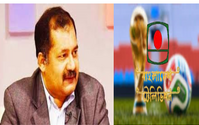
The FIFA World Cup is more than just a sporting event; in Bangladesh, it is a celebration that captivates millions of people. Every four years, the tournament transforms the country into a festival of football, from village streets to urban neighborhoods. However, beyond the excitement on the field, the acquisition and distribution of World Cup broadcasting rights have repeatedly generated public debate.
In particular, the contrasting approaches taken by Bangladesh Television (BTV) regarding the 2022 FIFA World Cup in Qatar and the upcoming 2026 FIFA World Cup have become a subject of national discussion. According to the government, the broadcasting rights for the 2026 World Cup have been acquired at nearly half the cost incurred in 2022. This has reignited questions about past expenditures, the role of intermediaries, and transparency in the use of public funds.
Just days before the start of the 2022 World Cup, on November 16, the Cabinet Committee on Government Purchase approved the acquisition of broadcasting rights for BTV. At the time, A H M Mustafa Kamal was serving as Finance Minister. The committee decided that BTV would obtain the rights through a direct procurement process from Toma Construction & Co. Ltd.
The decision immediately raised concerns. Although Toma Construction was a well-known construction and contracting company in Bangladesh, it had no prior involvement in the international sports broadcasting business. Many observers questioned how a construction company became an intermediary in the acquisition of broadcasting rights for one of the world's largest sporting events.
According to the Ministry of Information and Broadcasting at the time, the broadcasting rights had initially been acquired from FIFA by India's Viacom18. The rights subsequently passed through several entities before reaching the Norwester Omar K Sports Joint Venture, which later transferred them to Toma Construction. Ultimately, BTV purchased the rights from Toma.
This lengthy chain of intermediaries attracted widespread criticism. Analysts argued that every additional middleman increased the overall cost, with the financial burden ultimately falling on the state. Questions were raised as to why BTV did not negotiate directly with the original rights holder or source.
The controversy intensified when it became known that BTV spent approximately Tk 98 crore to broadcast the 64 matches of the 2022 World Cup. Although the Finance Division had initially considered an expenditure framework of around Tk 54 crore, the final approved amount nearly doubled that figure.
At the time, the Finance Division had recommended raising funds through sponsorships and advertising. However, officials argued that there was insufficient time before the tournament to secure alternative financing. Critics countered that the World Cup schedule had been known for years, making the claim of a last-minute time constraint difficult to justify.
Toma Construction's role remained at the center of the debate. The company's chairman, Ataur Rahman Bhuiyan, commonly known as Manik, argued that his company had also made a substantial investment in acquiring the rights and that the Tk 98 crore agreement was not unusual. He maintained that it was natural for a business enterprise to participate wherever legitimate commercial opportunities existed.
Critics, however, remained unconvinced. They questioned how a construction company entered the international broadcasting rights market and why the government did not pursue a direct purchase from the source. Allegations of close ties between the company and influential political figures also surfaced, although those involved consistently denied such claims.
Many of the questions surrounding the 2022 process have never been fully answered in the public domain. Concerns regarding the use of multiple intermediaries, the sharp increase in costs, and the lack of advance planning continue to be debated.
Four years later, the government claims to have adopted a completely different strategy for the 2026 FIFA World Cup. This time, Bangladesh Television has reportedly acquired the broadcasting rights directly from FIFA. According to official information, the agreement is valued at approximately US$3.85 million, equivalent to around Tk 47 crore. Including VAT and other taxes, the total expenditure is expected to reach approximately Tk 64 crore.
More importantly, the government claims that a significant portion of this cost has already been recovered through advertising revenue and the sale of broadcasting rights to telecommunications companies, satellite television channels, and OTT platforms. As a result, the burden on the national treasury has been substantially reduced.
This is where the most significant difference between 2022 and 2026 becomes apparent. In 2022, BTV spent approximately Tk 98 crore to broadcast 64 matches. In contrast, the 2026 World Cup, which will feature 104 matches, has reportedly been secured at a significantly lower overall cost. Although the market conditions, commercial value, and global economic circumstances surrounding the two tournaments are not identical, the difference in expenditure has naturally raised new questions among the public.
The role of Information and Broadcasting Minister Mohammad Ali Arafat's successor, Jahir Uddin Swapon, has also attracted attention. According to ministry sources, he played an active role in adopting and implementing a policy of direct negotiation with the rights holder. Supporters argue that the achievement is not merely about reducing costs but also about strengthening transparency and accountability in public procurement.
The current government's position is that excessive reliance on intermediaries and a lack of transparency contributed to the higher costs in 2022. State Minister for Information and Broadcasting Yasser Khan Chowdhury has stated that direct negotiations enabled significant savings while ensuring greater transparency in the procurement process.
Nevertheless, experts argue that further reforms are necessary. They believe that future acquisitions of broadcasting rights for major international sporting events should be conducted through a more institutionalized, competitive, and long-term framework. Such a system would minimize the risks associated with individual decision-making, intermediary influence, and procedural opacity.
Overall, the 2026 initiative appears to represent a new precedent in contrast to the controversial process of 2022. On one side are allegations of intermediary involvement, excessive expenditure, and questionable decision-making; on the other are claims of direct procurement, lower costs, and enhanced transparency.
As millions of football fans eagerly await the next World Cup, the economic and administrative story behind the television screens remains equally significant. The issue extends beyond the simple enjoyment of football. It concerns the proper use of public funds, accountability, and good governance. Citizens have the right to know where, how, and how effectively their tax money is being spent.
For that reason, the contrasting experiences of 2022 and 2026 represent more than two different administrative decisions. They serve as two distinct examples of public expenditure management, transparency, and accountability. Consequently, the story of World Cup broadcasting rights in Bangladesh is likely to remain an important case study in discussions of public procurement and governance for years to come.