

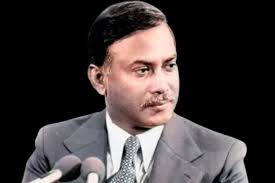
Lieutenant General Ziaur Rahman, Bir Uttom, remains one of the most significant figures in the history of Bangladesh. He was the proclaimer of the country’s independence, a brave freedom fighter, a distinguished military officer, a successful statesman, and the reintroducer of multi-party democracy in Bangladesh. His contribution to the political development of the country is profound and historically important. For his patriotism, courage, vision, and sacrifice, he continues to be remembered with deep respect by millions of people.
Early Life and Childhood
Ziaur Rahman was born on 19 January 1936 in Bagbari village of Bogura district. He was affectionately known as “Zia.” His father, Mansur Rahman, was a chemist and a government official, while his mother, Jahanara Khatun, was known for her kindness and religious devotion.
Part of his childhood was spent in the rural environment of Bogura, while another part was spent in Kolkata. After the partition of India in 1947, his family moved to Karachi. There he studied at Academy School and completed his secondary education in 1952. Later, he enrolled at D.J. College in Karachi. Even during his student life, he demonstrated discipline, leadership qualities, and a strong sense of patriotism.
Beginning of Military Career
In 1953, Ziaur Rahman joined the Pakistan Military Academy at Kakul as an officer cadet. He received his commission as a Second Lieutenant in 1955. Later, he joined the East Bengal Regiment and gradually earned recognition as a capable and courageous army officer.
He also served in military intelligence and took part in the Indo-Pakistani War of 1965. His unit displayed exceptional bravery in the Khemkaran sector. During different phases of his military career, he served as an instructor at the Pakistan Military Academy and Staff College.
In 1970, he was posted to Chattogram as the Second-in-Command of the Eighth East Bengal Regiment. At that time, political unrest in East Pakistan was intensifying, and the movement for the independence of Bangladesh was rapidly gaining momentum.
Role in the Liberation War
On the night of 25 March 1971, the Pakistani military launched “Operation Searchlight,” carrying out brutal genocide against the people of East Pakistan. In response to the atrocities committed against unarmed Bengalis, Major Ziaur Rahman revolted against the Pakistani military and joined the Liberation War.
On 26 March 1971, from the Kalurghat Radio Station in Chattogram, he first declared the independence of Bangladesh and later announced it on behalf of বঙ্গবন্ধু Sheikh Mujibur Rahman. His declaration inspired the nation and played an important role in organizing resistance against the Pakistani occupation forces.
As a sector commander, he made remarkable contributions to the Liberation War. Later, he formed the “Z Force” and led numerous operations on the battlefield. Under his leadership, freedom fighters established resistance in the Chattogram and Noakhali regions. During the war, he also established the first civil administration in Roumari, an area liberated from Pakistani occupation.
For his outstanding bravery and contribution to the Liberation War, the Government of Bangladesh awarded him the title “Bir Uttom,” the country’s second-highest gallantry award.
Rise in Post-Independence Bangladesh
After independence, Ziaur Rahman continued serving in the Bangladesh Army in several important positions. In 1972, he was appointed Deputy Chief of Staff. He was later promoted to Brigadier and subsequently to Major General. On 25 August 1975, he became the Chief of Army Staff.
Following the political upheavals of 1975, Bangladesh entered a period of severe instability. The events of 7 November 1975, often referred to as the Sepoy-People Revolution, brought Ziaur Rahman to the center of national politics. He later assumed the positions of Chief Martial Law Administrator and eventually President of Bangladesh.
On 21 April 1977, he officially took office as President. As head of state, he undertook initiatives to restore political stability, economic growth, and democratic governance in the country.
Restoration of Multi-Party Democracy
President Ziaur Rahman played a major role in restoring multi-party democracy in Bangladesh. After independence, political instability and the establishment of a one-party system had weakened democratic institutions. Zia allowed political parties to reorganize and restored freedom of the press.
On 1 September 1978, he founded the Bangladesh Nationalist Party (BNP). The central philosophy of his politics was “Bangladeshi Nationalism.” He believed that all citizens of Bangladesh, regardless of religion, ethnicity, or social background, should unite under a common national identity.
In the parliamentary elections of 1979, BNP won a landslide victory, leading to the revival of parliamentary politics in Bangladesh. His initiatives added a new dimension to democratic political culture in the country.
State Philosophy and Constitutional Changes
Ziaur Rahman introduced several important constitutional changes during his presidency. He inserted “Bismillahir Rahmanir Rahim” into the preamble of the Constitution and included the principle of “absolute trust and faith in Almighty Allah.”
His political philosophy emphasized nationalism, self-reliance, production-oriented economic policies, and participatory development. He followed pragmatic policies in state administration and placed importance on decentralization.
Economic Development and the 19-Point Program
Ziaur Rahman adopted extensive programs for economic development. During his rule, Bangladesh witnessed significant progress in agriculture, industry, infrastructure, and rural development.
He encouraged the growth of the private sector and returned many nationalized industries to their former owners. To increase agricultural production, he introduced subsidies for farmers, improved irrigation systems, and undertook canal excavation and restoration projects.
His famous 19-point program served as a comprehensive framework for the socio-economic development of the country. Its objectives included:
- Achieving self-sufficiency in food production
- Rural development
- Population control
- Expansion of education
- Women’s empowerment
- Youth development
- Administrative decentralization
- Building a self-reliant economy
He strongly believed in participatory development. Through the establishment of village governments and the Village Defence Party (VDP), he sought to involve rural communities directly in national development.
During his presidency, food production increased significantly, and economic growth improved notably. He also created nationwide awareness campaigns to encourage public participation in development activities.
Law, Order, and Military Discipline
After independence, Bangladesh faced serious law-and-order challenges. Ziaur Rahman strengthened the police force by increasing manpower and improving institutional capacity. He also restored discipline within the armed forces through strict measures.
He introduced modern training systems to enhance professionalism within the military. Although his strict actions against military rebellions and coup attempts drew criticism, he prioritized national stability above all else.
International Diplomacy and SAARC Initiative
Ziaur Rahman elevated Bangladesh’s international standing through active diplomacy. He established strong relations with the Muslim world, the United States, China, and Southeast Asian countries.
One of his most significant diplomatic contributions was the initiative to establish the South Asian Association for Regional Cooperation (SAARC). He envisioned a regional alliance to strengthen economic and political cooperation among South Asian nations. SAARC was formally established in 1985, inspired largely by his initiative.
Under his leadership, Bangladesh earned greater international recognition. In 1978, Bangladesh was elected as a non-permanent member of the United Nations Security Council.
Personal Life
In 1960, Ziaur Rahman married Khaleda Khanam, who later became widely known as Begum Khaleda Zia and served as Prime Minister of Bangladesh. They had two sons: Tarique Rahman and Arafat Rahman Koko.
In his personal life, he was known as a disciplined, modest, and religious individual. Despite holding the highest offices of the state, he remained deeply committed to family values and personal integrity.
Assassination and Death
On 30 May 1981, President Ziaur Rahman was assassinated during a military coup at the Chattogram Circuit House. His death created deep sorrow and uncertainty in the political life of Bangladesh.
His body was brought to Dhaka and buried at Sher-e-Bangla Nagar. Millions of people participated in his funeral prayers, and the nation mourned the loss of a prominent leader.
Evaluation and Legacy
Ziaur Rahman was a statesman of remarkable versatility. His courageous role in the Liberation War, the declaration of independence, his contribution to rebuilding the state, the restoration of multi-party democracy, and his efforts toward economic development remain important chapters in the history of Bangladesh.
His supporters regard him as one of the architects of modern Bangladesh. Despite political controversies and criticism, his vision, leadership, and development-oriented policies earned him a distinguished place in history.
He believed that a strong and self-reliant Bangladesh could only be built through the active participation of its people. His concept of “Bangladeshi Nationalism” continues to play a significant role in the political discourse of the country.
Shaheed President Ziaur Rahman represents a unique chapter in the history of Bangladesh. He was not merely a military officer or a president; he was a courageous leader who guided the nation during times of crisis. His contribution to the Liberation War, his administrative leadership, his restoration of democracy, and his development-oriented vision have made him an enduring figure in the nation’s history.
Although people pass away, their ideals and achievements continue to inspire future generations. Ziaur Rahman is such a figure whose memory, contributions, and legacy will remain alive in the hearts of the people of Bangladesh for generations to come.