

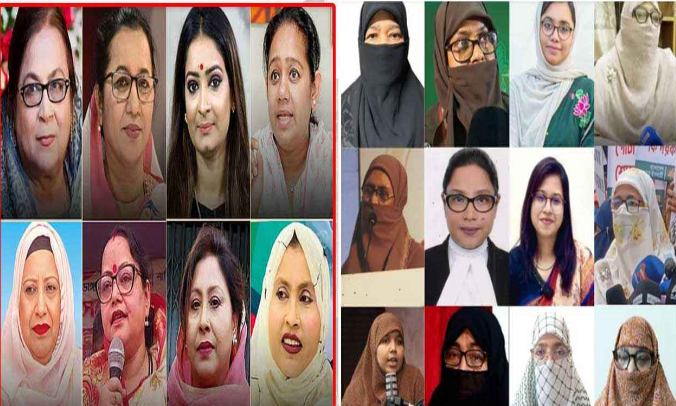
Ahead of the elections for the reserved women’s seats in Bangladesh’s 13th National Parliament, an analysis of candidates’ affidavits has revealed important insights into their educational qualifications, financial standing, political experience, and legal histories. The data published by the Election Commission shows that while a large proportion of candidates are highly educated, there is significant diversity in their economic and social backgrounds.
One of the most notable findings is that approximately 86 percent of the candidates contesting reserved women’s seats have higher education qualifications. This reflects a positive trend in women’s political participation in Bangladesh. The Bangladesh Nationalist Party (BNP) alliance stands out in this regard: 33 out of its 36 candidates are highly educated, indicating a clear emphasis on academic qualifications in their nomination process. In comparison, 9 out of 13 candidates from the Jamaat alliance have higher education, while the sole independent alliance candidate also holds a graduate degree.
In terms of financial status, the candidates present a wide spectrum—from millionaires to those dependent on modest incomes. Among the BNP alliance’s 36 candidates, 16 are millionaires. The wealthiest among them is Begum Selima Rahman, a member of the BNP Standing Committee. She has declared assets worth over BDT 68.8 million and an annual income exceeding BDT 3.6 million. She has previously served multiple terms as a Member of Parliament, reflecting her extensive political experience.
Similarly, candidates such as Shirin Sultana, Helen Jerin Khan, Sultana Ahmed, and Anna Minj have also reported assets amounting to several crores of taka. On the other hand, candidates like Nipun Roy Chowdhury, Johorat Adib Chowdhury, and Shamima Ara Begum Swapna have declared substantial annual incomes ranging from several lakhs to crores.
However, the opposite end of the spectrum is equally evident. Some candidates have very limited assets. For example, student leader Mansura Akhter has declared assets of only BDT 300,000. Others, such as Mosammat Suraiya Jerin, Madhabi Marma, and Selina Sultana, also report relatively modest financial positions. This indicates that women from diverse socioeconomic backgrounds are participating in the reserved seats election.
Political experience among the candidates also varies widely. Several candidates have previously served as Members of Parliament, including Rasheda Begum Hira, Rehena Akhter Ranu, Nilufar Chowdhury Moni, and Helen Jerin Khan. At the same time, newcomers like Sakila Farzana, Sansila Jebrin, and Mahmudah Habiba are entering parliamentary politics for the first time. This blend of experienced and new candidates could contribute to a more dynamic political environment.
Legal histories further differentiate the candidates. Many have faced multiple cases, while others have remained entirely free of legal issues. For instance, Nipun Roy Chowdhury had 23 cases against her but has since been acquitted or cleared of all charges. Similarly, Helen Jerin Khan was previously accused in 11 cases but has been released from all of them. In contrast, candidates like Bilkis Islam and Nilufar Chowdhury Moni have never faced any legal proceedings.
Candidates from the Jamaat alliance show similar diversity. Individuals such as Nurunnisa Siddika, Sabikun Nahar, Mahfuza Hannan, and Tasmia Pradhan are highly educated and earn through professions like teaching. However, their overall asset levels tend to be comparatively lower than those of BNP candidates.
The sole independent alliance candidate, Sultana Jesmin, also reflects this diversity. Although she had five cases filed against her, all were withdrawn last year. She has declared an annual income of approximately BDT 550,000 and assets worth around BDT 2.85 million.
According to the Election Commission’s announced schedule, appeals against returning officers’ decisions will take place on April 26, with disposal of appeals scheduled for April 27 and 28. The final date for withdrawal of candidacy is April 29, and election symbols will be allocated on April 30. Voting is set to take place on May 12. Notably, if a seat has only one candidate, that candidate will be declared elected unopposed after the withdrawal deadline.
Overall, this analysis highlights that candidates for the reserved women’s seats are not only diverse in terms of educational qualifications but also in financial capacity, social standing, and political experience. This reflects an expanding scope of women’s participation in Bangladesh’s political landscape and underscores the importance of inclusive representation. At the same time, it raises critical questions about the role of economic disparity in political participation and how such gaps might be addressed in the future.
Ultimately, this election is not just about representation; it is also a significant test of the diversity, capability, and future direction of women’s leadership in Bangladesh.