

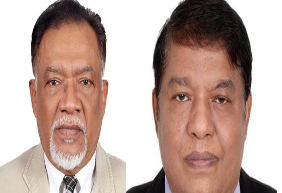
There had been longstanding discussions within the Bangladesh Nationalist Party (BNP) over filling the vacant positions on its highest policymaking body, the National Standing Committee. Amid these discussions, BNP Chairman and Prime Minister Tarique Rahman appointed four leaders as members of the party’s National Standing Committee. Among the four new members, Advocate Ruhul Kabir Rizvi and Amanullah Aman are long-standing and well-known figures in BNP politics. Both have notable backgrounds in student politics and have played prominent roles in the party’s political activities over the years.
However, the appointments of former secretary Md. Ismail Jabiullah and cancer specialist Professor Dr. Farhad Halim Donar have generated particular interest both within and outside the party. Although they have been less visible in mainstream grassroots politics in recent years, both have maintained longstanding ties with the BNP and have experience in organisational affairs, professional bodies and election-related activities.
Four New Members Join the 19-Member Standing Committee
The BNP National Standing Committee has 19 positions. Before the latest appointments, 13 members were serving on the committee. They are—Tarique Rahman, Khandaker Mosharraf Hossain, Rafiqul Islam Mia, Mirza Abbas, Gayeshwar Chandra Roy, Abdul Moyeen Khan, Nazrul Islam Khan, Mirza Fakhrul Islam Alamgir, Amir Khosru Mahmud Chowdhury, Salahuddin Ahmed, Selima Rahman, Iqbal Hasan Mahmud Tuku and A.Z.M. Zahid Hossain.
One of the committee’s members, Barrister Jamiruddin Sircar, died on July 12. With the addition of the four new members, the number of serving members has now risen to 17.
If BNP Secretary General Mirza Fakhrul Islam Alamgir assumes the office of president, he would have to relinquish his party position. In that event, another position on the Standing Committee could become vacant, creating an opportunity to fill the remaining vacancies in the 19-member policymaking body.
Who Is Md. Ismail Jabiullah?
Former secretary Md. Ismail Jabiullah is an experienced retired civil servant who held several important positions in the government during his long administrative career. Under the government led by Prime Minister Tarique Rahman, he has also been appointed as an adviser to the Prime Minister with the rank and status of a full minister.
Jabiullah’s ancestral home is in Moktar Bari, Ward No. 7, Char Kadira Union, in Kamalnagar upazila of Lakshmipur. During his career in public administration, he served as secretary in several important ministries and divisions. In 2005, he served as Secretary of the Ministry of Shipping under the then BNP government. Earlier, he also served as secretary of the Economic Relations Division and the Ministry of Social Welfare.
After retiring from government service, Jabiullah became more closely associated with the BNP. He served as an adviser to the BNP Chairperson and later as a member of the party’s Advisory Council.
Ahead of the 2026 national parliamentary election, he was given the responsibility of chief coordinator of the BNP’s Central Election Management Committee. He was also seen representing the BNP at meetings with the Election Commission.
In the same year, Jabiullah was nominated as a member of the Standing Committee of the International Conference of Asian Political Parties (ICAPP) as a representative of the BNP.
His extensive administrative experience, knowledge of policymaking and longstanding involvement with the BNP’s organisational activities are believed to have contributed to his appointment to the party’s highest policymaking body.
Who Is Professor Dr. Farhad Halim Donar?
Professor Dr. Farhad Halim Donar is known primarily as a physician, cancer specialist and leader in professional organisations. He previously served as the project director of the National Institute of Cancer Research and Hospital.
Alongside his medical career, Dr. Donar has been associated with the Doctors Association of Bangladesh (DAB) for many years. He has served as the organisation’s convener and is currently its chief adviser. He has also served as the executive director of the Ziaur Rahman Foundation.
Dr. Donar has also maintained a longstanding involvement in BNP politics. He served as an adviser to the BNP Chairperson and as acting convener of the BNP’s Dhaka North City unit.
Ahead of the 2026 national parliamentary election, he was also included in the BNP’s Central Election Management Committee.
Dr. Donar has remained involved in higher education and research in addition to his medical and political activities. On June 29, he was elected unopposed as a member of the Syndicate of the University of Dhaka as a distinguished citizen at the university’s annual Senate session.
Two Leaders with Different Professional Backgrounds
The BNP’s National Standing Committee has traditionally been composed of long-serving and tested political leaders with extensive experience in grassroots politics, organisational activities and movements. From that perspective, the inclusion of Ismail Jabiullah and Dr. Farhad Halim Donar represents a somewhat different approach.
Jabiullah brings extensive experience in public administration, state affairs and policymaking. Dr. Donar, on the other hand, brings decades of experience in the healthcare sector, professional organisations and BNP-linked activities.
Their involvement in important party activities, election management, professional organisations and policymaking, combined with their respective professional expertise and longstanding political association with the BNP, is believed to have played a role in their elevation to the party’s highest policymaking forum.
Meanwhile, the inclusion of Ruhul Kabir Rizvi and Amanullah Aman can be viewed as a continuation of the BNP’s tradition of elevating leaders with deep roots in grassroots and student politics.
With the addition of the four new members, the BNP’s National Standing Committee has not only gained further representation from experienced political leaders but has also incorporated expertise from public administration, healthcare and professional organisations.