

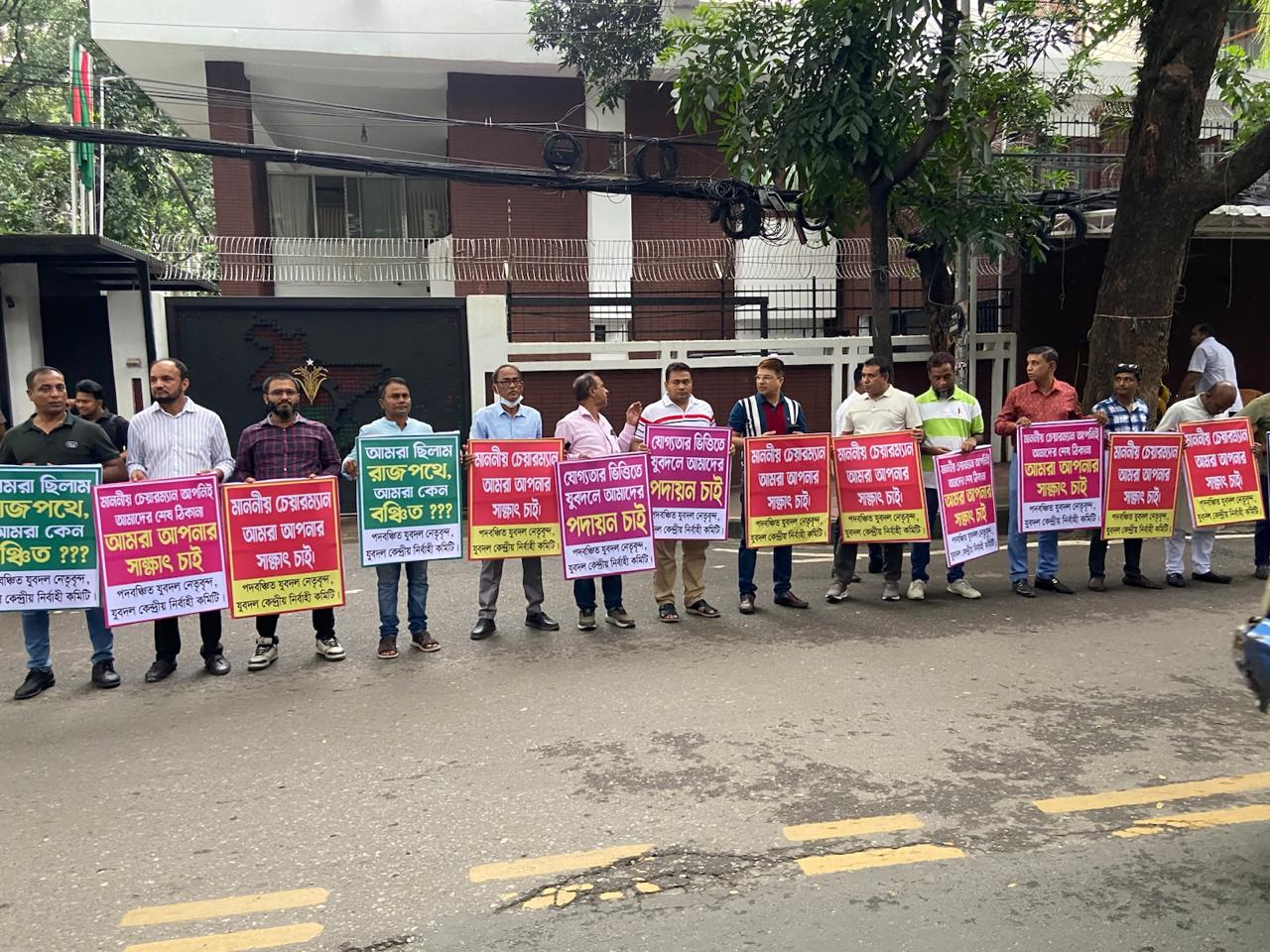
A human chain was held in front of the BNP Chairman’s Office on Thursday, August 13, 2026, by former leaders of Chhatra Dal and Jubo Dal who had been active and committed participants in the street movement against the fascist Sheikh Hasina government.The protesters demanded a reconsideration of the recently announced central executive committee of Jubo Dal, alleging that many long-serving, tested and dedicated leaders who had participated in the party’s movements and struggles had been excluded from the 151-member committee.
The leaders alleged that the 151-member central executive committee of Jubo Dal was announced on June 4. Since its announcement, leaders who were deprived of positions have described the committee as a “pocket committee” and a “farce committee” allegedly formed to serve the interests of a particular group.
According to the protesters, many leaders who had remained active in street movements for years, endured repression and demonstrated loyalty to the party during difficult times were excluded from the committee. In contrast, they alleged, some politically inactive, relatively unknown and controversial individuals were given important positions.
The protesters further alleged that disagreements had previously arisen between the president and general secretary of Jubo Dal over the inclusion of controversial individuals in the committee. They claimed that the disagreement eventually turned into a heated verbal confrontation, including the use of informal and disrespectful language. The incident was subsequently reported by several national newspapers, they said.
The speakers at the human chain also alleged that most members of the 151-member committee had not been visibly active in the party’s street movements and struggles during its difficult period. They further claimed that some individuals maintained business and social relationships with leaders associated with the Awami League and attempted to maintain their positions by adjusting to the prevailing political circumstances.
Expressing concern over the future of the party, the leaders said that if BNP faced another difficult political period, some of the controversial individuals currently holding important positions might abandon the party or leave the country. Such a situation, they warned, could adversely affect the party’s organizational activities and future movements.
The protesters called upon the BNP policymakers to take immediate steps in the greater interest of Jubo Dal. They demanded that the allegations surrounding the formation of the committee be reviewed, if necessary through an impartial investigation, and that controversial individuals be removed if the allegations are substantiated.
They also demanded that long-serving, dedicated, persecuted and active leaders who had been excluded from the committee be given appropriate consideration and included in the central committee.
The leaders further said that they would continue their efforts to meet the BNP Chairman and inform him directly about their allegations concerning irregularities in the formation of the Jubo Dal central committee. They said their efforts to secure a meeting with the party’s top leadership would continue until their demands were addressed.
The protesters called for organizational transparency, recognition of dedicated leaders and effective measures to strengthen Jubo Dal ahead of any future political movement.
Leaders Present
Among those present at the human chain were former vice-president of the central Chhatra Dal, Rafiqul Islam Rafiq, along with Humayun Kabir, Sajjad Hossain Ujjal, Zakir Hossain Khan, former central Jubo Dal affairs secretary Rion Talukdar, former joint general secretary of the central Chhatra Dal Abul Hasan, former joint general secretary Mahfuzur Rahman Mahfuz, former vice-president of Dhaka North Chhatra Dal Hafizur Rahman Hafiz, former organizing secretary Khaled Mahmud Masud, former assistant sports secretary Aman Ullah Bipul, former assistant health affairs secretary of Jubo Dal Bachedur Rahman Sohel, former organizing secretary of Chhatra Dal Golam Azam Sekat, former assistant organizing secretary Azizul Haque Patowary, former general secretary of Chhatra Dal’s Zia Hall unit at Dhaka University Belal Hossain Emon, and former member Masud Ahmed.
Also present were Jubo Dal central executive committee member Mizanur Rahman Khan; former vice-president of Dhaka University Chhatra Dal Sharif Al Farhad Dipu; former joint general secretary of the central Chhatra Dal Ismail Hossain; former assistant general secretary Kazi Mezbaul Alam; Mujahidul Islam, Anwar Zahid, former assistant general secretary Mohammad Arif, Sumon Chowdhury, former assistant organizing secretary Masud Sarker, former assistant organizing secretary Sabur Khan Sagar, former joint general secretary Rakibul Islam Rokon, former assistant general secretary Fazlul Haque Nirob, former assistant organizing secretary Jahangir Alam, former non-government affairs secretary Yakub Raju, former assistant organizing secretary Shafiul Azam, former climate affairs secretary Swapan Kumar Mondal, former assistant sports secretary Robiul Hasan Arif, former vice-president of Dhaka University Chhatra Dal Nazrul Islam Nahid, Bishwajit Bhadra and Farid Khan.
Other participants included former member Mohibullah Joy, former student leader Selim Reza, former relief affairs secretary of the central Chhatra Dal Azim Uddin Miraj, former member M. Kamrul Islam, senior vice-president of the Dhaka University Ziaur Rahman Hall Chhatra Dal Khasru Ahmed Hiron, former general secretary of the Institute of Education and Research (IER) at Dhaka University Kabir Ahmed, former student leader of Jagannath University Khandaker Aminul Haque Akon, former assistant sports secretary of the central Chhatra Dal Majedul Islam Masum, former Dhaka University student leader Jasim Uddin Siddiqui Shovon, former Jubo Dal leader Main Uddin Beg Sujon, former Jagannath University student leader Nazrul Islam, former student leaders Emdadul Haque Parvez, Zahidul Islam Hiron, Amir Hossain Badsha, former Jubo Dal leader Mahmud Khan, former Dhaka East metropolitan Chhatra Dal leader Dulal Matbar, and former student leaders Masud Rana and Manik Hossain, among others.The participants reiterated that they would remain firm in their demands and continue their efforts through organizational and democratic means until the grievances of the deprived and dedicated leaders were properly addressed.