

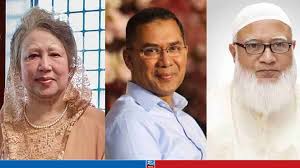
As the next national election, scheduled for February, draws closer, one question dominates Bangladesh’s political conversation — who will be the country’s next prime minister? Even before the election results, political, diplomatic, and analytical circles in Dhaka are abuzz with speculation. Some suggest that if the BNP (Bangladesh Nationalist Party) comes to power, Begum Khaleda Zia might become the President, while Tarique Rahman would serve as the Prime Minister. Others believe that if Khaleda Zia regains full health, she could once again assume the role of head of government herself.
Past Experience and New Context
Ahead of the 2018 national election, foreign diplomats held a meeting with senior BNP leaders at a Dhaka hotel. Their direct question was simple: “If your party forms the government, who will be the Prime Minister?”
At that time, party Chairperson Begum Khaleda Zia was imprisoned, while Acting Chairman Tarique Rahman was in London. Consequently, BNP leaders failed to give a clear answer.
Seven years later, that same question has resurfaced—this time not only about the BNP, but also about potential prime ministerial candidates from other parties or alliances. If the 13th National Parliamentary Election indeed takes place in February as the interim government has indicated, the discussion will likely intensify further.
BNP’s Internal Calculations
Following the political shift of August 5, 2024, the BNP has found itself back in serious contention for power. Recently, party Secretary General Mirza Fakhrul Islam Alamgir stated:
“If our Chairperson Khaleda Zia is healthy and able to work, she will be the Prime Minister. In her absence, our Chairman Tarique Rahman will assume that responsibility. There is no disagreement within the party on this matter.”
Some insiders believe that if the BNP forms the next government, the power structure might follow something similar to Saudi Arabia’s ‘King–Crown Prince’ model — with Khaleda Zia as the formal Prime Minister and Tarique Rahman acting as chief policymaker and administrative advisor.
Meanwhile, the party’s younger generation argues that Tarique Rahman’s leadership could make BNP’s politics more modern and dynamic.
Jamaat and NCP’s Position
The Bangladesh Jamaat-e-Islami, the country’s largest religion-based political party, has already announced candidates for all 300 parliamentary constituencies. However, the party has not yet clarified who would become Prime Minister if it manages to form a government.
Asked about the issue, Assistant Secretary General Hamidur Rahman Azad said:
“Let the election take place first. We will see who gets elected, and then the leadership question will be considered.”
The National Citizen Party (NCP) — a youth-driven political group formed in the spirit of the July Uprising — is also being mentioned in power-sharing discussions. The party may contest either independently or as part of an alliance.
Senior Joint Convener Samanta Sharmin said:
“We have made a policy decision to separate the roles of party chief and head of government. It would be premature to say now who might become the head of government if we form one.”
Awami League’s Uncertain Future
For more than a decade, Bangladesh effectively operated under a one-party rule, with the Awami League holding power continuously. However, recent political upheavals have removed the party from power, and its organizational activities are currently banned.
Sources suggest that efforts are underway to reorganize the Awami League, but it remains unclear whether Sheikh Hasina will return to lead, or if new leadership will emerge.
As a result, discussions about the party’s participation in the next election—or who might become Prime Minister if it somehow wins—remain distant and uncertain.
Analysts’ Perspectives
Political analysts note that the question of “Who will be the next Prime Minister?” in Bangladesh is not merely about individuals; it is also a reflection of the country’s democratic maturity, leadership transparency, and institutional accountability.
Political commentator Mohiuddin Khan Mohon observed:
“At present, three political parties are being discussed as potential power contenders. One of them might win 10 to 15 seats, another might fail to win any. Only the BNP appears capable of producing the next head of government. If Khaleda Zia is healthy, she will be the Prime Minister; if not, Tarique Rahman will lead.”
International trade and political analyst Mobasher Hossain Tutul added:
“The character and leadership qualities of a head of government deeply influence how a state is run. When a party declares its potential Prime Minister before the election, voters can make more informed choices, and accountability improves.”
He cited the United Kingdom as a recent example of leadership instability:
“The Conservatives (Tories) had to change several Prime Ministers within a short period, leading to political chaos and ultimately their electoral defeat to Labour. For the sake of stability and public confidence, Bangladeshi parties should also announce their prime ministerial candidates before the election.”
Conclusion
So far, no political party in Bangladesh has officially named its prospective Prime Minister—except the BNP, which has offered a partial indication.
As a result, the country’s future leadership scenario remains open to interpretation. Diplomats, media outlets, and political observers continue to speculate, but the definitive answer is yet to emerge.
Prime Ministers of Bangladesh (1971–2024)
| Name | Tenure | Party |
|---|---|---|
| Tajuddin Ahmad | April 17, 1971 – January 12, 1972 | Awami League |
| Sheikh Mujibur Rahman | January 12, 1972 – January 24, 1975 | Awami League |
| Mohammad Mansur Ali | January 25, 1975 – August 15, 1975 | Awami League |
| Mashiur Rahman | June 29, 1978 – March 12, 1979 | JAGODAL / BNP |
| Shah Azizur Rahman | April 15, 1979 – March 24, 1982 | BNP |
| Ataur Rahman Khan | March 30, 1984 – January 15, 1985 | Jatiya Party / Jondal |
| Mizanur Rahman Chowdhury | July 9, 1986 – March 27, 1988 | Jatiya Party |
| Moudud Ahmed | March 27, 1988 – August 12, 1989 | Jatiya Party |
| Kazi Zafar Ahmed | August 12, 1989 – December 6, 1990 | Jatiya Party |
| Khaleda Zia | March 20, 1991 – 1996 (briefly) and 2001 | BNP |
| Sheikh Hasina | 1996, 2008, 2014, 2018, and 2024 | Awami League |