

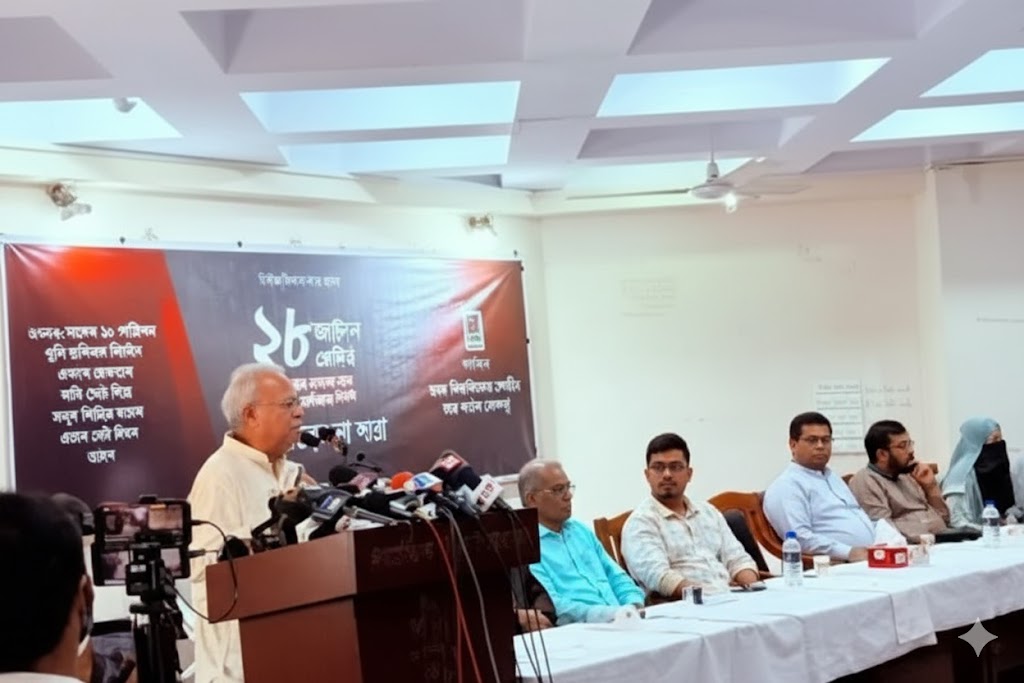
BNP Senior Joint Secretary General Advocate Ruhul Kabir Rizvi has said that October 28, 2006, marked the beginning of fascist politics in Bangladesh under Sheikh Hasina’s leadership. He described the violent events of that day as “the first manifestation of fascism” in the country’s political history.Rizvi made these remarks on Tuesday (October 28) while speaking at a discussion titled “October 28 in Context: From the Politics of Corpses to the Rise of Awami Fascism,” organized by the Dhaka University Central Students’ Union (DUCSU).
“On that day, Prime Minister Begum Khaleda Zia was in the process of resigning, but the law enforcement agencies stopped listening to the government,” Rizvi said. “The administration became biased, and Sheikh Hasina and her party took advantage of the situation to unleash a bloody assault on four-party alliance activists. That was the first staging of fascism in Bangladesh.”
He cited the brutal beating of Jatiyatabadi Chhatra Dal president Shahabuddin Laltoo as a “horrific example of Sheikh Hasina’s fascist politics.”
“The way an injured man was crushed with bricks and the killers rejoiced over his body was an act of calculated cruelty — Bangladesh had never witnessed such brutality before,” he said.
Rizvi alleged that the October 28 killings were premeditated, claiming that Sheikh Hasina began reshaping the administration and law enforcement with political loyalty “just as Hitler built his Aryan state.”
“Since then, Sheikh Hasina has applied the same strategy in her administration — rewarding only those who show partisan allegiance,” he said.
“Sheikh Hasina Created a State-Centered Ideology”
The BNP leader argued that Sheikh Hasina has built an ideology of “state worship” similar to that of Adolf Hitler.
“For her, the state means the Awami League. Anyone who dissents or thinks outside this framework is branded a traitor,” he said.
Rizvi added that the fascism established in Bangladesh is not only political but also social and administrative, claiming that under Sheikh Hasina’s rule, the bureaucracy, law enforcement, and judiciary have all been guided by partisan loyalty.
He also mentioned that the United Nations Secretary-General at the time condemned the 2006 violence, saying it was an early sign of the authoritarian path that Bangladesh would later face.
“DUCSU’s Initiative Symbolizes Democratic Revival”
Commending DUCSU for organizing an open discussion on the topic, Rizvi said:
“This kind of free discussion represents a democratic reawakening. Universities must become centers of free thought and truth-seeking.”
He cautioned that fascist ideologies often distort national consciousness.
“Sheikh Hasina’s so-called ‘consciousness’ equates opposition voices with treason. Our youth must stand against this false narrative and defend truth and freedom,” he said.
Rizvi concluded by saying that the long struggle for democracy has not been in vain.
“Those of us who have endured repression for the past 15–16 years in the fight for democracy now see that the young generation is reviving that democratic spirit — and that is the strongest answer to Sheikh Hasina’s fascism.”
The discussion was presided over by DUCSU Vice President Abu Sadiq Kayem.