

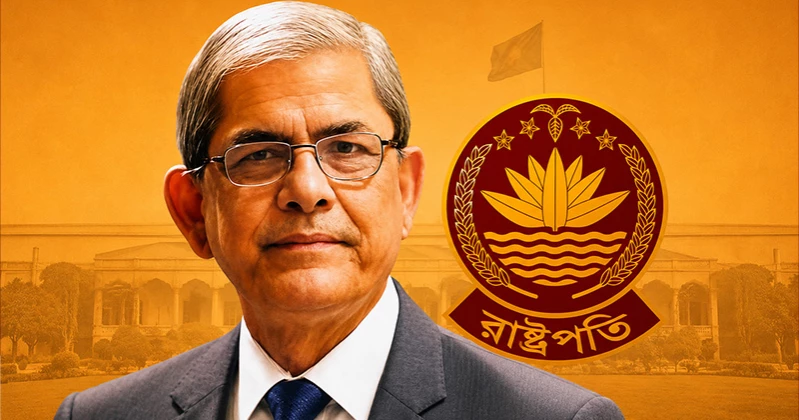
BNP candidate Mirza Fakhrul Islam Alamgir has unofficially been elected as the 23rd President of Bangladesh.Mirza Fakhrul defeated his lone rival Col (retd) Oli Ahmad, the contender from the 11-party opposition alliance, led by Bangladesh Jamaat-e-Islami, by a huge margin in the presidential election held in the session chamber of the Jatiya Sangsad Bhaban on Thursday. He obtained 255 votes, while Oli Ahmad polled 88.Chief Election Commissioner (CEC) AMM Nasir Uddin, also Returning Officer of the election, announced the polls results after the balloting ended at 5:00pm.
“Mirza Fakhrul Islam Alamgir has secured 255 votes. I declare that, having received the highest number of votes, he has been duly elected President,” Nasir Uddin announced.
Out of all 343 valid votes, Mirza Fakhrul secured 255, while Oli Ahmad got 88, he said.
Among the 349 voters, six lawmakers did not vote in the presidential election.
The six voters who did not turn up are BNP lawmakers Mirza Abbas, Mostafa Kamal Pasha and Dr Muhammad Osman Farruk, independent lawmaker Rumeen Farhana, Jamaat lawmaker Gazi Nazrul Islam and Islami Andolan Bangladesh lawmaker Md Oli Ullah.
Soon after the announcement of the results, Prime Minister Tarique Rahman congratulated Mirza Fakhrul with a red rose.
Immediately after the declaration, he rose from his seat, shook hands with the newly elected President and presented him with the red rose.
Lawmakers across the Parliament Chamber congratulated Fakhrul by thumping their desks.
The newly elected President then raised his hand and greeted the lawmakers, who continued applauding him by thumping their desks.
Leader of the Opposition Dr Shafiqur Rahman, Deputy Leader of the Opposition Syed Abdullah Mohammed Taher and other opposition lawmakers then came towards the treasury bench.
Fakhrul left his seat and first embraced Shafiqur Rahman after opposition MPs came towards the treasury bench.
Prime Minister Tarique Rahman then came forward from his seat and embraced Fakhrul.
Tarique and Shafiqur Rahman also embraced each other.
Lawmakers from both the ruling and opposition parties subsequently exchanged greetings with the newly elected President.
The atmosphere in the Parliament Chamber turned celebratory following the announcement of the results.
Fakhrul later shook hands with CEC Nasir Uddin, who conducted the presidential election, and greeted other election officials.
The Election Commission will now publish the election results in an official gazette by today.
On the other hand, Bangabhaban is making preparations to arrange the oath-taking ceremony for the newly elected President on Friday evening.
Earlier, voting was held from 2:00pm to 5:00pm, with Members of Parliament (MPs) casting their votes through an open ballot to elect the country’s 23rd President.
At the beginning of the balloting, acting President Hafiz Uddin Ahmad and acting Speaker Barrister Kayser Kamal cast their votes at 2:10pm, while Prime Minister Tarique Rahman and Mirza Fakhrul cast theirs at 2:11pm.
Just before the balloting, CEC Nasir Uddin announced the names of the two candidates and explained the voting procedure for MPs.
Since the Chattogram-4 parliamentary seat remains vacant, the number of voters was 349.
The voters include 247 BNP lawmakers, 77 Jamaat MPs, eight NCP lawmakers, eight independent MPs, three Bangladesh Khilafat Majlis MPs, and one each from Bangladesh Jatiya Party-BJP, Gono Odhikar Parishad, Ganosamhati Andolon, Khilafat Majlis, Islami Andolan Bangladesh and Jatiya Ganatantrik Party.
BJP, Gono Odhikar Parishad and Ganosamhati Andolon are allies of the ruling BNP. The ruling camp has 250 lawmakers.
On the other hand, Jamaat, NCP, Bangladesh Khilafat Majlis, Khilafat Majlis and Jatiya Ganatantrik Party are components of the 11-party opposition alliance. The opposition camp has 90 lawmakers in Parliament.
The last contested presidential election was held on October 8, 1991, when BNP candidate Abdur Rahman Biswas defeated Awami League candidate Badrul Haider Chowdhury to become the country’s 11th President.
Abdur Rahman Biswas secured 172 votes, while Badrul Haider Chowdhury received 92.
Since then, no voting was required in the successive presidential elections as a single candidate was elected uncontested in each election.
On July 24 last, Mohammed Shahabuddin resigned as President and Speaker Hafiz Uddin Ahmad took charge as the acting President.
According to Article 123(2) of the Constitution, an election to fill the vacant office of the President must be held within 90 days of the post becoming vacant due to resignation.