

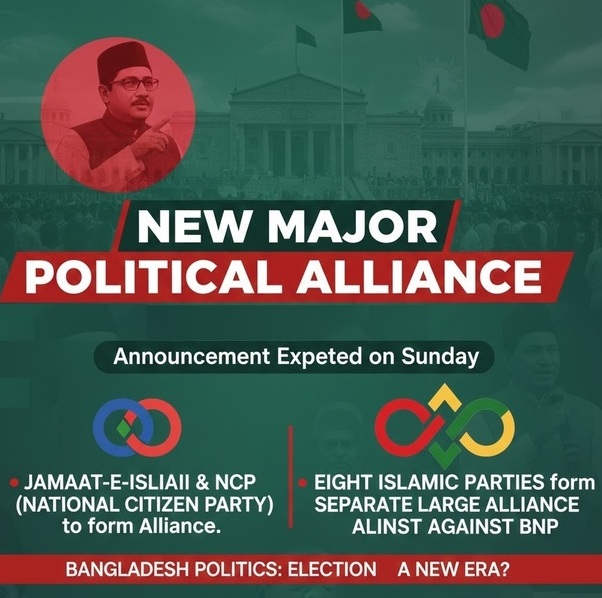
Bangladesh’s political landscape is witnessing renewed discussion following indications of an emerging major political alliance. According to various political and diplomatic sources, Jamaat-e-Islami and the newly formed political party NCP (National Citizen Party) are set to enter into a formal alliance, with an official announcement expected today, Sunday. At the same time, reports suggest that eight Islamic political parties are preparing to form a large alliance aimed at positioning themselves against the BNP. These developments signal a possible new political realignment and strategic shift ahead of the upcoming national election.
From Rumors to Political Reality
For several months, speculation has surrounded Jamaat-e-Islami’s political future and strategic direction. Some narratives suggested the party was becoming politically marginalized, while others claimed it was quietly strengthening its organizational base. Recent developments indicate that Jamaat is actively pursuing strategic alliances as part of a broader effort to reorganize and reassert its political relevance. Political analysts view the potential alliance with the NCP as a calculated move within this broader strategy.
Although the NCP is a relatively new political force, it has drawn attention among young voters and urban citizens through its emphasis on civic politics, governance reform, and institutional accountability. If finalized, the alliance between Jamaat and the NCP could produce both opportunities and challenges for both parties, creating a complex political equation.
Efforts to Unite Islamic Political Parties
Alongside this development, reports indicate that eight Islamic political parties—separate from Jamaat—are working toward forming a unified political bloc. The primary political positioning of this alliance is expected to be against the BNP. Historically, Islamic political parties in Bangladesh have contested elections in a fragmented manner, often leading to vote splitting and limited electoral success. Observers believe this new initiative reflects lessons learned from past experiences and a desire to consolidate influence.
If successful, such unity could create a coordinated Islamic political bloc with greater electoral impact. However, analysts caution that the durability of this alliance will depend on leadership arrangements, seat-sharing agreements, and ideological consensus among the participating parties.
A New Challenge for the BNP?
The BNP has long been recognized as the principal opposition force in Bangladesh’s political arena. The emergence of a coordinated Islamic alliance could pose a new challenge, particularly if it attracts a segment of the BNP’s traditional voter base. Some analysts suggest that the presence of a united Islamic front may alter electoral dynamics in several constituencies.
Nevertheless, the BNP’s extensive organizational structure, political experience, and nationwide network remain significant strengths. As such, analysts urge caution against assuming any immediate weakening of the party solely due to the formation of new alliances.
Jamaat’s Confidence and Political Calculations
Jamaat-e-Islami leaders appear increasingly confident about their political prospects in the changing landscape. According to party leaders, years of organizational preparation have positioned Jamaat to face upcoming political challenges more effectively. The pursuit of new alliances is seen as a reflection of this renewed confidence.
Jamaat leaders have expressed the belief that the proposed alliance could emerge as a victorious force in the next national election. However, political observers emphasize that electoral success depends on multiple factors beyond alliances, including public support, political credibility, the electoral environment, and administrative neutrality.
Jamaat Ameer Dr. Shafiqur Rahman, speaking at various public gatherings, has stated that the party places its trust in the people. He has pledged that if Jamaat forms the government, it will work for public welfare and strive to establish a just and welfare-oriented state based on fairness and accountability.
Conclusion
Overall, Bangladesh appears to be entering a potentially new phase in its political journey. The possible alliances involving Jamaat-e-Islami, the NCP, and other Islamic parties may add new dimensions to the country’s political equation. Whether these initiatives materialize and how they resonate with voters will become clear over time.
For a healthy and responsible political environment, transparency, democratic practice, and peaceful competition remain essential. Jamaat’s Secretary General has also expressed hope that if the process of forming new alliances proceeds within these principles, it could contribute positively to the country’s democratic development.